
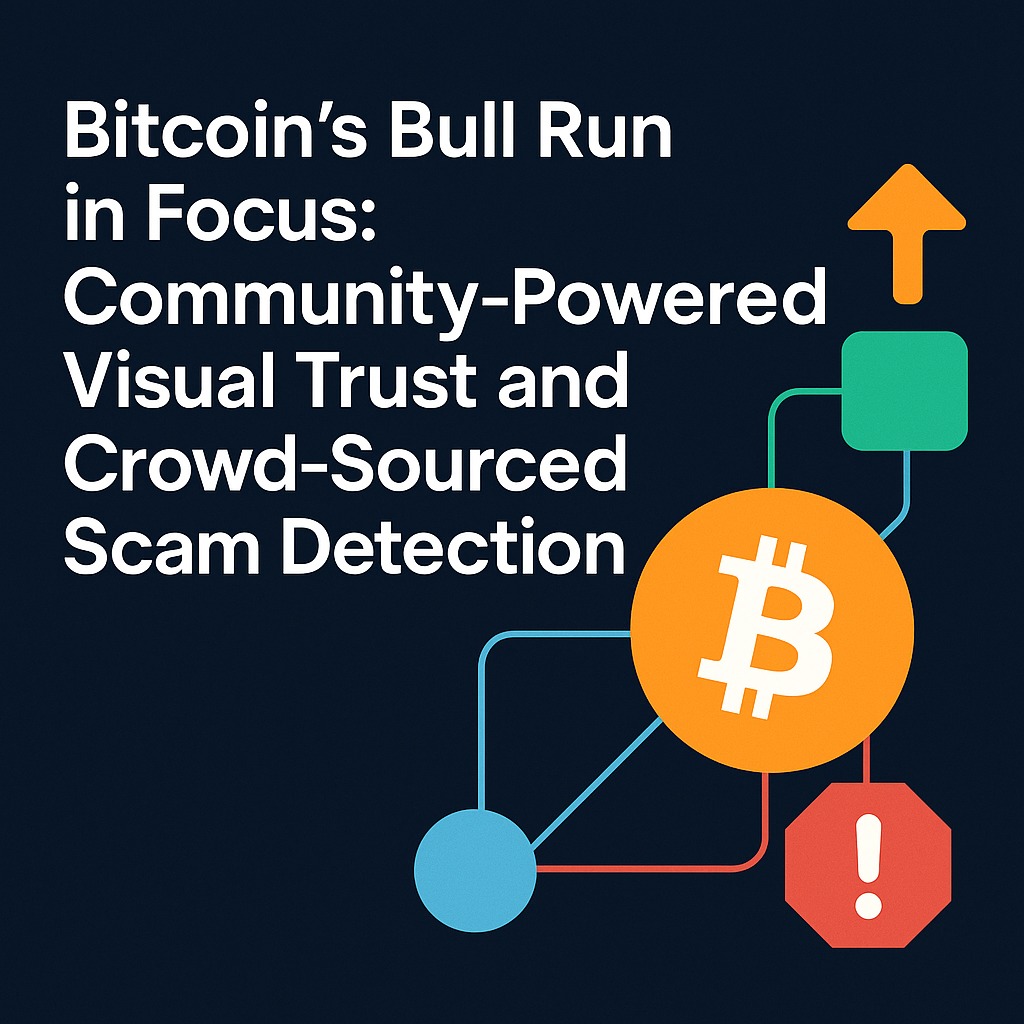
Bitcoin’s latest bull run is pulling in both eager investors and opportunistic scammers, leading to billions in losses every year. Visual trust infrastructure—turning raw blockchain data into clear shapes, colors, and flows—makes that on-chain activity readable, while tools like Hindsight VIP’s Lighthouse Alerts and the crowd-powered Samaritan Network help ordinary users spot scams in real time and participate safely during volatile markets.
Want real-time scam alerts while Bitcoin runs? Try Lighthouse alerts free for 30 days →
Understanding Bitcoin Bull Runs
A Bitcoin bull run is a period when price rises quickly and consistently, driven by optimism and new capital entering the market. Previous cycles in 2013, 2017, and 2021 took BTC from hundreds to thousands to tens of thousands of dollars, and 2025 is showing early signs of another strong move.
Yet every cycle repeats the same pattern: excitement, media hype, a wave of newcomers—and then a surge in scams that target urgency and inexperience rather than price direction alone.
Why Bull Runs Always Attract Scams
Bull runs draw in two key groups: inexperienced newcomers and highly motivated fraudsters.
- Newcomers rush in on social proof and FOMO, often skipping even basic due diligence.
- Fraudsters exploit that with phishing, fake projects, copycat tokens, and social engineering, using influencers, bots, and clone websites to create the illusion of consensus.
Chainalysis estimates scams and hacks drained more than $24 billion across 2022–2023, with rug pulls, phishing, and fake investments leading the way. The core problem behind these losses is not a lack of data—but a lack of comprehension.
The Transparency Paradox
Blockchains like Bitcoin and Ethereum are fully transparent: every transaction, contract deployment, and token transfer is recorded on-chain and visible to anyone. In theory, this should make scams easy to detect.
In practice, explorers overwhelm users with hashes, hex strings, and low-level logs that most people cannot interpret, creating a “transparency paradox” where everything is visible but almost nothing is understandable. This confusion is precisely where scams thrive, because malicious contracts and poisoned wallets look identical to legitimate ones until you have the tools to translate what you are seeing.
Turn raw hashes into human-readable risk signals: Explore Hindsight’s visual blockchain tools →
Visual Trust Infrastructure: Making Blockchain Readable
Visual trust infrastructure replaces walls of code with a simple visual grammar so users can understand risk at a glance.
- Rings = Wallets (storage of value)
- Squares = Smart contracts (logic and rules)
- Triangles = Exchanges (trading venues)
- Arrows = Token flows (movement of value)
- Colors = Safety levels (green safe, orange caution, red likely scam)
Like a subway map, you do not need to understand the engineering of the rails; you just follow the lines and signals. This approach lets newcomers in a Bitcoin bull run see whether they are interacting with a safe wallet or a flagged contract, without needing to read Solidity or transaction traces.
For a deeper explainer on this visual language, see “Colors, Shapes, Safety: Blockchain Made Simple.
Community-Powered Protection: The Samaritan Network
Scammers collaborate; defenders need to as well. Hindsight VIP’s Samaritan Network is a crowd-sourced safety layer where users flag suspicious wallets, contracts, and flows so the entire community benefits.
- Users report suspicious entities based on experience or investigation.
- These signals are aggregated, cross-checked, and scored.
- Verified scam intelligence propagates as visual warnings and alerts before others interact with the same threat.
It functions like a neighborhood watch for blockchain: one person’s close call becomes thousands of people’s early warning. That network effect is critical during a bull run, when new victims appear every minute.
Help turn scams into shared intelligence: See how Samaritan and Lighthouse work together →
Real-Time Safety With Lighthouse Alerts
In fraud, timing is everything. Rug pulls drain liquidity in seconds, phishing approvals empty wallets in a single click, and compromised contracts can redirect funds instantly.
Lighthouse Alerts change the equation by monitoring wallets and contracts in real time, then pushing warnings within roughly 30 seconds when suspicious activity touches your surface area. Instead of discovering damage after the fact, users get a live prompt that lets them cancel, revoke, or pause before losses become permanent.
A typical scenario:
- A new user is about to approve a contract during a Bitcoin bull run.
- Lighthouse detects that this contract matches patterns from dozens of previous scam tokens.
- A high‑risk alert appears: “This contract has been flagged as high risk based on prior scam behavior. Do not approve.”
That one alert can be the difference between experimentation and catastrophe.
For more on real-time scam defense, see “Real-Time Crypto Scam Alerts with Lighthouse: Staying Safe in Fast-Moving Markets.
Spotlight Verification: Knowing Who You’re Dealing With
Visual risk scores work best when paired with positive verification. Spotlight Verification lets projects, DAOs, and influencers verify their official wallets inside Hindsight VIP.
Users then see:
- Verified wallets with a clear, visual checkmark and entity context.
- Impostor addresses that lack verification and often carry community risk flags.
This sharply reduces impersonation scams—especially common during bull runs when fake “official” wallets pop up across social media, airdrops, and Discord servers.
Why Visual Trust Matters in This Bull Run
Bitcoin’s current rally is drawing in millions of new participants who have never used a block explorer or hardware wallet before. Visual trust infrastructure meets them where they are:
- Newcomers gain confidence by following green vs. red visual cues instead of raw code.
- Businesses accept Bitcoin with more peace of mind by verifying counterparties visually.
- Educators can teach blockchain with diagrams and dashboards instead of only CLI output.
- Regulators and compliance teams see systemic risk in visual form, not just CSV exports.
The result is not just fewer scams—it is broader inclusion. More people can participate in a bull run without needing to become protocol engineers first.
Want visual trust on top of your existing wallets and exchanges? Start your Lighthouse trial and connect your wallets →
Quick FAQ
Can scammers trick visual trust infrastructure?
It is difficult at scale because scam scores blend algorithmic analysis with community reporting; anomalies and false positives are constantly corrected as new data flows in.
Is Bitcoin still safe to invest in?
Bitcoin’s protocol remains robust; most losses come from social engineering, fake contracts, and phishing rather than flaws in Bitcoin itself. Pairing research with tools like Lighthouse Alerts and the Samaritan Network dramatically reduces those external risks.
Do I need technical skills to use Hindsight VIP and Lighthouse?
No. Visual signals and plain-language alerts replace low-level blockchain jargon so beginners and non-technical users can act safely.
From Chaos to Clarity
Bull runs will always create excitement, volatility, and opportunistic fraud, but they no longer have to put newcomers at a structural disadvantage. With visual trust infrastructure, Lighthouse Alerts, and the Samaritan Network, everyday users can finally see what is really happening on-chain before they click “approve.”